

Gene Editing Market Size to Surpass USD 42.13 Billion by 2034
According to Nova One Advisor, the global gene editing market size is calculated at USD 11.29 billion in 2025 and is expected to surpass around USD 42.13 billion by 2034, growing at a compound annual growth rate (CAGR) of 15.76% over the forecast period 2025 to 2034. A study published by Nova One Advisor a sister firm of Precedence Research.
Ottawa, Nov. 04, 2025 (GLOBE NEWSWIRE) -- The global gene editing market size is calculated at USD 9.75 billion in 2024, grew to USD 11.29 billion in 2025, and is projected to surpass around USD 42.13 billion by 2034. The market is projected to expand at a CAGR of 15.76% between 2025 and 2034.
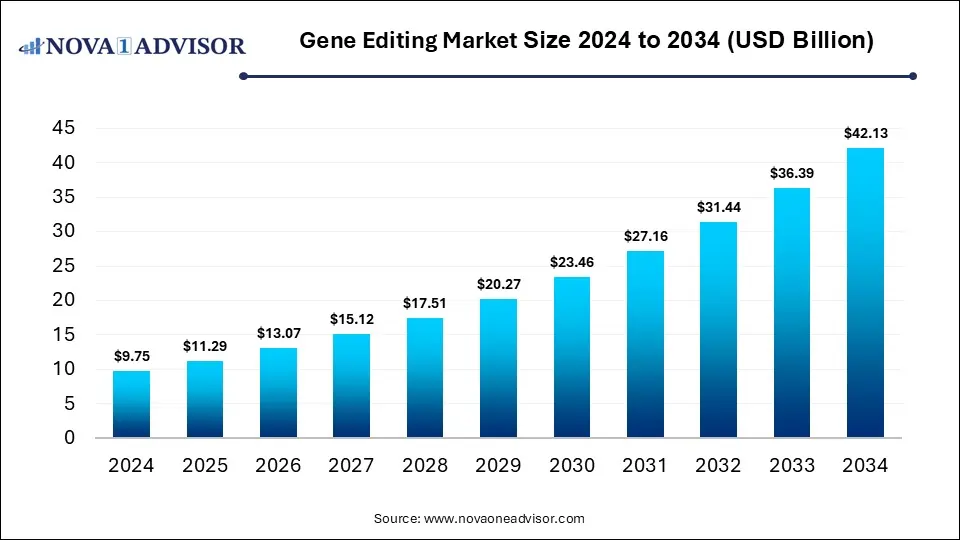
Gene Editing Market Key Takeaways
- North America dominated the gene editing market with the revenue shares in 2024.
- Asia Pacific is expected to grow at the fastest CAGR in the market during the forecast period.
- By technology, the CRISPR-Cas9 gene editing segment held the largest market share in 2024.
- By technology, the transcription activator-like effector-based nucleases segment is expected to grow at a significant rate in the market during the forecast period.
- By application, the gene editing segment dominated the market with a major revenue share in 2024.
- By application, the cell line engineering segment is expected to grow at the fastest CAGR in the market during the forecast period.
- By end user, the biotechnology and pharmaceutical companies segment led the market in 2024.
- By end user, the academic and government research institutes segment is expected to grow at the fastest CAGR in the market during the forecast period.
Download a Sample Report Here@ https://www.novaoneadvisor.com/report/sample/2224
What is Gene Editing?
The global gene editing market is growing as this technology continues to develop, and second-generation genome editing tools are recognized. This expertise has detonated at a magnificent pace and has renovated in different areas, including chromatin imaging, gene modulations, and engineering in the laboratory and preclinical settings in various species.
What are the Key Drivers in the Gene Editing Market?
Gene editing holds tremendous potential not only in medical care but also in the sector of agriculture. The application of gene editing processes to alter crop genomes has become a subject of widespread discussion and research in recent years. This provides the opportunity to improve food security, reduce waste, and address complexities stemming from climate change. Additionally, there is potential to ultimately remove the requirement for destructive pesticides, advantageous both to consumers and the environment at large. Though, despite its vast potential, gene editing in crops is not yet broadly carried out, mainly due to uncertainties regarding the safety of the end-products.
Available for purchase directly at- https://www.novaoneadvisor.com/report/checkout/2224
Gene Editing Market Report Scope
| Report Attribute | Details |
| Market size value in 2025 | USD 11.29 Billion |
| Revenue forecast in 2034 | USD 42.13 Billion |
| Growth rate | CAGR of 15.76% from 2025 to 2034 |
| Base year for estimation | 2024 |
| Historical data | 2021 - 2024 |
| Forecast period | 2025 - 2034 |
| Quantitative units | Revenue in USD million/billion and CAGR from 2025 to 2034 |
| Report coverage | Revenue forecast, company ranking, competitive landscape, growth factors, and trends |
| Segments covered | By Technology, By Application, By end User, By Region |
| Regional scope | North America; Europe; Asia Pacific; Latin America; MEA |
| Country scope | U.S.; Canada; Mexico; Germany; UK; France; Italy; Spain; Norway; Denmark; Sweden; China; Japan; India; South Korea; Australia; Thailand; Brazil; Argentina; Saudi Arabia; South Africa; UAE; Kuwait |
| Key Companies Profiled | Beren Therapeutics, Agilent Technologies, Creative Biogene, Thermo Fisher-Scientific, Synthego, Integrated DNA Technology, Bean Therapeutics, Intellia Therapeutics, Lonza, Horizon Discovery Group plc., Tecan Life-Sciences, Bluebird Bio |
| Customization scope | Free report customization (equivalent to up to 8 analyst working days) with purchase. Addition or alteration to country, regional & segment scope. |
For more information, visit the Nova One Advisor website or email the team at sales@novaoneadvisor.com | Call us : +1 804 420 9370
What’s the Difference?
Gene Therapy vs. Gene Editing
Simply put, gene editing is a type of gene therapy. Both approaches target the cause of a disease, such as a gene variant (i.e. mutation or change), by using genetic material to treat or prevent disease by making sure the right amount of protein is produced – this is essential for proper body functions. A common gene therapy approach called gene addition may deliver a working copy of a gene in place of the faulty one, whereas gene editing delivers the tools that will directly modify pieces of DNA inside the cell to correct or remove the problem.
How Gene Editing Works
Gene editing can be delivered into cells using in vivo or ex vivo methods. In vivo means the gene editing components are delivered directly into the body to make edits within the cells. While ex vivo means the cells are removed from the body, edited in a specialized laboratory and then returned to the patient’s body. To address different types of disorders and their cause, there are a few common gene editing approaches used:
- Gene integration - For conditions where not enough protein is produced, gene editing can introduce corrections. This means that the correct DNA sequence is added into the genome so that it can produce working proteins.
- Gene activation - For conditions where not enough protein is produced, gene editing can make an edit to activate a silent gene that was inactive.
-
Gene knock out - For conditions where a faulty gene may cause too much of a protein or dysfunctional proteins to be produced, gene editing can silence or “knock out'' certain genes in a cell. This approach alters or removes the problematic DNA sequence entirely.
Gene Editing Technologies
There are several kinds of gene editing technologies. While they all work slightly differently, they share the same goal of making precise, often lasting changes to the DNA or RNA. Let’s explore the different types of technology and some conditions they are currently being studied in:
- Zinc Finger Nucleases and TALENs: These are proteins that bind to specific DNA sequences to make cuts that add, remove, or replace genetic material at specific sites. These tools create targeted edits with double strand breaks to DNA but are more complex and take longer to design compared to the CRISPR system. Conditions being explored with this approach include Hunter Syndrome and HIV.
- CRISPR Cas9: Think of this like a GPS-guided editor. It uses two core components, the first being a small piece of RNA, called a guide RNA, that finds the exact spot in the DNA where a change is needed. The second component is a protein, called a Cas9 enzyme which cuts the DNA at that location. This cut allows scientists to turn off a gene or remove, add, or replace sections of DNA. Conditions being explored with this approach include certain cancers and blood disorders, such as sickle cell disease.
Newer technologies can correct genetic challenges without cutting the entire DNA or RNA strands, offering more precision and reducing potential risk:
- Base Editing: This approach acts like a pencil which makes small, single-letter changes of the nucleotide base in DNA or RNA. This may work for fixing conditions caused by a single-letter mistake called a point mutation. Currently, base editing can only switch certain letter pairs, like changing A to G or C to T. Conditions being explored with this approach include sickle cell disease, and metabolic disorders.
- Prime Editing: Working as an accurate search and replace tool, this approach can add, remove or swap short sections of DNA—not just one letter—to make complex changes such as changing TAG to TAC. Conditions being explored with this approach include cystic fibrosis, Tay-Sachs disease, and retinal disorders.
- Gene Regulation: These approaches do not change the DNA by cutting it but work to turn a gene on or off by modifying how the genes are read. The two types include:
- CRISPR activation (CRISPRa) turns genes on to produce more of a helpful protein.
-
CRISPR interference (CRISPRi) turns genes off to reduce or block harmful proteins.
What are the Ongoing Trends in the Gene Editing Market?
- In October 2025, Chiesi buys into Arbor's gene editing drug for rare kidney disease. The Italian drugmaker will pay as much as $115 million in upfront and near-term payments in a deal that gives it rights to a treatment in early-stage testing for main hyperoxaluria type 1.
- In October 2025, Eli Lilly and Company and Adverum Biotechnologies, Inc. entered into a definitive agreement under which Lilly acquired Adverum Biotechnologies, including its lead product candidate, Ixo-vec. The announcement was made jointly by the companies from Indianapolis and Redwood City, California.
- In October 2025, Alethio Therapeutics, a biotech company advancing therapies designed to support people with Myeloproliferative Neoplasms (MPNs) live longer, healthier, and more fulfilling lives, emerges from stealth with two antibody-drug conjugate (ADC) programmes and the appointments of Dr Rohit Batta as Chief Executive Officer and Mike Grey as Chair of the Board. Backed by deep scientific and clinical expertise, Alethio Therapeutics is focused on translating its discovery insights into a pipeline of precision, disease-modifying therapies.
What is the Emerging Challenge in the Gene Editing Market?
Mosaicism is a challenge related to medical germline editing, in which numerous populations of cells that have various genetic makeups exist in a single edited patient's body. Mosaicism might occur if genetic editing happened after the division of the initial single-cell embryo into two cells. Mosaicism is difficult because the genetic problem to be prohibited may still occur if all the cells in the embryo do not have the anticipated edit.
Regional Analysis
Why did North America Dominate the Market in 2024?
By capturing a major share, North America registered dominance in the market in 2024, with increasing spending in R&D, modern research infrastructure, the presence of major biotechnology organizations, and a helpful government environment. North America boasts advanced research laboratories, universities, and medical care facilities that adopt cutting-edge research and invention in gene editing and genomics. Growing spending in gene editing technology in this region, for instance, till September 2025, Gene Therapy companies in North America have raised $997M in equity funding in 20 rounds.
How did the Asia Pacific Grow Notably in the Market in 2024?
During 2025-2034, the Asia Pacific is anticipated to expand at a rapid CAGR in the gene editing market as continuous technological development in gene editing tools, such as the development of more specific and effective CRISPR-Cas9 variants, prime editing systems, and base editing. Noteworthy government support, increasing R&D investments, a massive patient population, and a focus on targeted medicine and cultivated biotechnology. The region hosts many biotechnology and pharmaceutical organizations and a strong research infrastructure. Rising startups in this region. For Instance, in January 2025, a Bengaluru biotech start-up opens a lab to develop disease diagnostics with gene editing tech. The research team at the laboratory is headed by a group of women with a track record in molecular diagnostics, genomic science, and gene editing.
Segmental Insights
By technology analysis
Which Technology Led the Gene Editing Market in 2024?
The CRISPR-Cas9 gene editing segment accounted for the dominating share of the market in 2024, as CRISPR/Cas9 provides simplicity and effectiveness in genome editing, allowing quicker gene modifications straight in embryos compared to the outdated embryonic stem (ES) cell-driven process. CRISPR/Cas9 procedure straight on embryos, it is incredible to select the anticipated event, significantly limiting the possibility of identifying the inte allele. CRISPR/Cas9 genome engineering technology has provided researchers with a precious tool to accelerate the generation of mouse models for biomedical in vivo study.
Whereas the transcription activator-like effector-based nucleases segment is predicted to register rapid expansion in the forecasting period, as transcription activator-driven effector nucleases (TALEN) are designer nucleases that use a highly conserved DNA-binding domain resulting from bacterial proteins to target particular DNA sequences for genome modification. They engineered to cleave the DNA at intended locations, driving the removal of mutated genomes in different organisms and human cells.
By application analysis
How did the gene editing Segment Dominate the Market in 2024?
In 2024, the gene editing segment captured the biggest share of the gene editing market as gene editing is a process that goal to extract particular genes carrying necessary traits from an organism (human, plant, animal, or microbe) and artificially assign them to the genes of an additional organism to transfer that intended trait to the receiving organism. Gene editing processes that support preventing diseases such as HIV and cancer, make crops hardier, and challenge environmental challenges. It can be used to develop more effective cancer immunotherapies, support the combat of acquired diseases such as AIDS, and even allow the de-extinction of species.
Although the cell line engineering segment will expand fastest during 2025-2034, as cell-line advancement thus remains a bottleneck in drug advancement, particularly recently, companies are increasingly developing therapies based on particles that don’t exist in nature. Enhancements in the cell-line expansion workflow must remove the bottleneck in drug discovery. Enhancements in the cell-line development workflow removed the bottleneck in drug discovery.
By end-user analysis
How did the biotechnology and pharmaceutical companies dominate the Market in 2024?
The biotechnology and pharmaceutical companies segment held the biggest share of the gene editing market in 2024, as genome editing is one of the main applications of CRISPR-Cas9 in biotechnology. It allows accurate modifications in the DNA sequences of various organisms, including yeast, bacteria, plants, and animals. The novel CRISPR-Cas9 technology has transformed the sector of biotechnology, offering significant tools for genome editing, gene regulation, and synthetic biology.
On the other hand, the academic and government research institutes segment will expand fastest as the development of gene editing technologies is very promising for the treatment of genetic diseases. However, gene editing can also be used to improve the properties of healthy individuals. Researchers effectively create cell and animal models with particular gene knockouts, knock-ins, or mutations to research gene function and the molecular foundation of disease pathogenesis.
Top Companies in the Gene Editing Market
- Beren Therapeutics
- Agilent Technologies
- Creative Biogene
- Thermo Fisher-Scientific
- Synthego
- Integrated DNA Technology
- Bean Therapeutics
- Intellia Therapeutics
- Lonza
- Horizon Discovery Group plc.
- Tecan Life-Sciences
- Bluebird Bio
What are the Recent Developments in the Gene Editing Market?
- In October 2025, SandboxAQ releases AQCat25-EV2, a new quantitative AI model trained on the AQCat25 dataset; Illumina launches BioInsight, a new business within Illumina developed to meet industry demand for deeper biologic insights; Thermo Fisher Scientific introduces the Applied Biosystems SwiftArrayStudio Microarray Analyzer; and more.
- In August 2025, the U.S. Food and Drug Administration has placed a clinical hold on Intellia Therapeutics' (NTLA.O), opens new tab two late-stage trials testing an experimental gene therapy for a rare disease that can damage the heart and nerves, the company. The FDA's decision follows a serious safety event in one of the trials, where a patient who received the therapy, called nexiguran ziclumeran (nex-z)
- In October 2025, Intellia Therapeutics, Inc., a leading clinical-stage gene editing company focused on revolutionizing medicine with CRISPR-based therapies, announced that the company has temporarily paused patient dosing and screening for its MAGNITUDE and MAGNITUDE-2 Phase 3 clinical trials of nex-z for patients with transthyretin amyloidosis with cardiomyopathy (ATTR-CM) and polyneuropathy (ATTR-PN)
More Insights in Nova One Advisor:
- CRISPR-based Gene Editing Market - The global CRISPR-based gene editing market size was valued at USD 6.15 billion in 2024 and is anticipated to reach around USD 24.37 billion by 2034, growing at a CAGR of 14.76% from 2025 to 2034.
- Generic Drugs Market - The global generic drugs market size is calculated at USD 488.35 billion in 2024, grows to USD 515.21 billion in 2025, and is projected to reach around USD 834.17 billion by 2034, expanding at a CAGR of 5.5% during the forecast period from 2025 to 2034.
- Gene Therapy Media Market - The global gene therapy media market size was estimated at USD 462.25 million in 2024 and is expected to reach USD 2,279.59 million in 2034, expanding at a CAGR of 17.3% during the forecast period of 2025 and 2034.
- Cell and Gene Therapy Market - The global cell and gene therapy market size was estimated at USD 21.85 billion in 2024 and is projected to hit around USD 119.30 billion by 2034, growing at a CAGR of 18.5% during the forecast period from 2025 to 2034.
- Generator Sales Market- The global generator sales market size was exhibited at USD 32.25 billion in s and is projected to hit around USD 56.41 billion by 2034, growing at a CAGR of 5.75% during the forecast period 2025 to 2034.
- Generic Injectable Market - The global Generic Injectable Market Size was valued at USD 117.25 billion in 2024 and is predicted to be worth USD 442.36 billion by 2034, with a CAGR of 14.2% from 2025 to 2034.
- Gene Panel Market - The global gene panel market size was USD 4.85 billion in 2024, calculated at USD 5.72 billion in 2025 and is expected to reach around USD 25.17 billion by 2034, expanding at a CAGR of 17.9% from 2025 to 2034.
- U.S. Cell and Gene Therapy Market - The U.S. cell and gene therapy market was valued at USD 6.35 billion in 2024 and is projected to hit around USD 51.15 billion by 2034, growing at a CAGR of 23.2% during the forecast period 2025 to 2034.
- U.S. Cell And Gene Therapy Clinical Trials Market - The U.S. cell and gene therapy clinical trials market size is calculated at USD 5.35 billion in 2024, grows to USD 5.92 billion in 2025, and is projected to reach around USD 14.68 billion by 2034, growing at a CAGR of 15.62% from 2025 to 2034.
- Cell And Gene Therapy Clinical Trials Market - The global cell and gene therapy clinical trials market size reached USD 15.85 billion in 2024 and is projected to hit around USD 64.74 billion by 2034, expanding at a CAGR of 15.11% during the forecast period from 2025 to 2034.
- U.S. Cell And Gene Therapy Clinical Trial Services Market - The U.S. cell and gene therapy clinical trial services market size was valued at USD 9.45 billion in 2024 and is projected to surpass around USD 69.65 billion by 2034, registering a CAGR of 22.11% over the forecast period of 2025 to 2034.
- CAR T-Cell Therapy Market - The global CAR T-Cell therapy market size was valued at USD 15.75 billion in 2024 and is projected to surpass around USD 223.9 billion by 2034, registering a CAGR of 30.4% over the forecast period of 2025 to 2034.
- Cell & Gene Therapy Contract Research Organizations Market - The global cell & gene therapy contract research organizations market size is calculated at USD 5.35 billion in 2024, grows to USD 5.88 billion in 2025, and is projected to reach around USD 13.76 billion by 2034, growing at a CAGR of 9.91% from 2025 to 2034.
- Cell And Gene Therapy CDMO Market - The global Cell And Gene Therapy CDMO market size was estimated at USD 7.52 billion in 2024 and is projected to hit around USD 88,84 billion by 2034, growing at a CAGR of 28.1% during the forecast period from 2025 to 2034.
- Clinical Oncology Next Generation Sequencing Market - The global clinical oncology next generation sequencing market size is calculated at USD 474.55 million in 2024, grows to USD 551.43 million in 2025, and is projected to reach around USD 2,129.82 million by 2034, at a 16.2% CAGR during the forecast period for 2025-2034.
- General Anesthesia Drugs Market - The global general anesthesia drugs Market size is expected to be worth around USD 8.45 Billion by 2034 from USD 5.85 Billion in 2024, growing at a Compound Annual Growth Rate (CAGR) of 3.75% during the forecast period from 2025 to 2034.
- Gene Therapy Platform Market - The gene therapy platform market size was exhibited at USD 2.75 billion in 2024 and is projected to hit around USD 11.52 billion by 2034, growing at a CAGR of 15.4% during the forecast period 2025 to 2034.
- Cell And Gene Therapy Bioanalytical Testing Services Market - The Cell and gene therapy bioanalytical testing services market size was exhibited at USD 541.25 million in 2024 and is projected to hit around USD 1,107.26 million by 2034, growing at a CAGR of 7.42% during the forecast period 2025 to 2034.
Gene Editing Market Report Segmentation
This report forecasts revenue growth at global, regional, and country levels and provides an analysis of the latest industry trends in each of the sub-segments from 2019 to 2034. For this study, Nova One Advisor has segmented the global gene editing market
Segments Covered in the Report
By Technology
- Zinc Finger Nucleases (ZFNs)
- CRISPR-Cas9 Gene Editing
- Restriction Enzymes
- Others
- Transcription Activator-Like Effector-based Nucleases (TALENs)
By Application
- Drug development
- Others
- Gene editing
- Cell Line Engineering
- Animal Genetic Engineering
- Plant Genetic Engineering
By end User
- Biotechnology and Pharmaceutical Companies
- Academic and Government Research Institutes
- Contract Research Organizations
By Regional
- North America
- Europe
- Asia Pacific
- Latin America
- Middle East and Africa (MEA)
Immediate Delivery Available | Buy This Premium Research Report (Global Deep Dive USD 3800) https://www.novaoneadvisor.com/report/checkout/2224
About-Us
Nova One Advisor is a global leader in market intelligence and strategic consulting, committed to delivering deep, data-driven insights that power innovation and transformation across industries. With a sharp focus on the evolving landscape of life sciences, we specialize in navigating the complexities of cell and gene therapy, drug development, and the oncology market, enabling our clients to lead in some of the most revolutionary and high-impact areas of healthcare.
Our expertise spans the entire biotech and pharmaceutical value chain, empowering startups, global enterprises, investors, and research institutions that are pioneering the next generation of therapies in regenerative medicine, oncology, and precision medicine.
Our Trusted Data Partners
Towards Chemical and Materials | Precedence Research | Statifacts | Towards Packaging | Towards Healthcare | Towards Food and Beverages | Towards Automotive | Towards Consumer Goods | Nova One Advisor | Nutraceuticals Func Foods | Onco Quant | Sustainability Quant | Specialty Chemicals Analytics | Towards Chem and Material
Web: https://www.novaoneadvisor.com/
Contact Us
USA: +1 804 420 9370
Email: sales@novaoneadvisor.com
For Latest Update Follow Us: LinkedIn


Legal Disclaimer:
EIN Presswire provides this news content "as is" without warranty of any kind. We do not accept any responsibility or liability for the accuracy, content, images, videos, licenses, completeness, legality, or reliability of the information contained in this article. If you have any complaints or copyright issues related to this article, kindly contact the author above.
